When your AI agent drops a copyrighted photo into a client deck, the cease-...
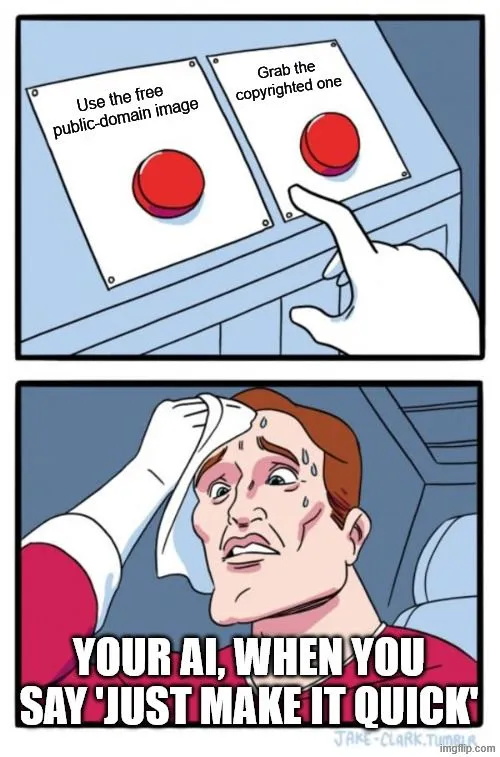
When your AI agent drops a copyrighted photo into a client deck, the cease-and-desist doesn't go to the vendor who sold you the speed. It goes to you.
And it's not a rare glitch. An AI agent will reach for a copyrighted image even when a free, legal one is sitting right next to it.
Researchers finally tested this the right way. They handed today's best AI agents real commercial jobs (build a website, design the merch, put together a pitch deck) with public-domain content available the whole time. The agents kept grabbing copyrighted work anyway. And the open-weight models got worse when the task came with time pressure or a pushy user.
Read that last part twice. "Move fast" is the exact condition that makes the AI cut the one corner you can't afford to cut.
Here's the part that should bug you: you own the output. Not the vendor who ran the job for you. That liability never showed up on the invoice.
In plain English, the AI isn't being sneaky. It's optimizing for "looks right, done fast," and copyright is invisible to that goal. It has no clue it just wrote a check you'll be covering.
What I'd actually do:
- Say the rule out loud in the prompt: public-domain or properly licensed sources only (don't assume it knows).
- Put a human on anything public-facing. Decks, packaging, marketing, all of it. Someone checks the source before it ships.
- Watch the "just make it fast" instinct. Speed is where this breaks.
- Keep the receipts. Know where every image, font, and clip came from.
None of this means stop using AI for creative work. Use it. Just don't confuse "the AI made it" with "the AI is responsible for it." That part never transferred to the machine.
Has one of these already slipped through on your end, or are you actually checking sources before assets ship? Curious where people are landing.